The global financial crisis a decade ago and the resulting recession left long-lasting scars on future growth in more ways than one.

Our October World Economic Outlook points to signs that the crisis may have had lasting effects on potential economic growth through its impact on fertility rates and migration, as well as on income inequality.

Our chart of the week shows that in the decade before the crisis, the fertility rate—the number of children each woman is expected to have in her lifetime—rose in several advanced economies, only to decline afterward.

The crisis may have had lasting effects on potential economic growth through its impact on fertility rates and migration.
Astronaut in Space
John Doe
Researcher

A state-level look at fertility illustrates the strength of the correlation between lower birth rates and economic distress. States experiencing the largest economic declines in 2007 and 2008 were most likely to experience relatively large fertility declines from 2008 to 2009, the analysis finds. States with relatively minor economic declines were likely to experience relatively small declines.

For example, North Dakota, which experienced one of the nation’s lowest unemployment rates (3.1%) in 2008, was the only state to show even a slight increase (0.7%) in births from 2008 to 2009. All other states and the District of Columbia experienced either no change, or declines, in births during that period.

These correlations are based on fertility trends calculated using data from the National Center for Health Statistics and the U.S. Census Bureau and economic trend data from six familiar indicators (per capita income, per capita gross domestic product, employment rate, unemployment rate, initial unemployment claims, and foreclosure rates) tracked by the Bureau of Economic Analysis, the Bureau of Labor Statistics and RealtyTrac.

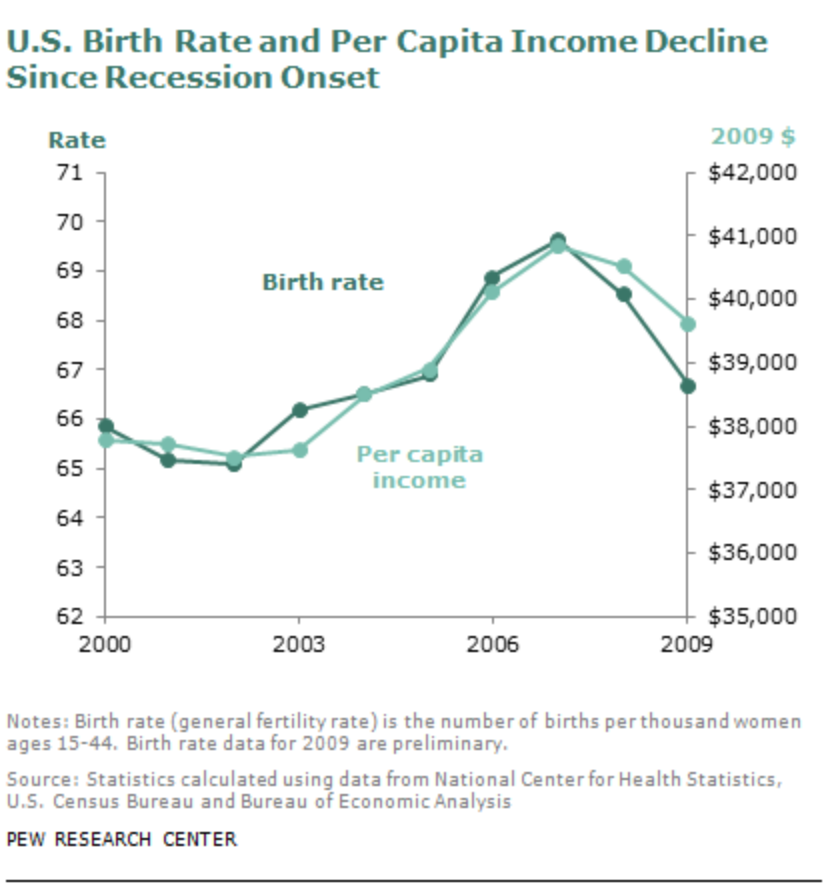
In 48 of 51 states (a number that includes the District of Columbia), fertility declines occurred within one to two years of the start of economic declines (as indicated by the percent change in personal income per capita, and the percent change in the employment rate). This does not conclusively prove that the economic changes led to fertility changes. However, the timing is consistent with the time it might take people to act upon fertility decisions.